Most yard drainage problems are fixed by sending water the right way before you try to bury it: extend or bury the downspouts, regrade soil so it falls away from the house, and shape a swale where runoff crosses the yard. A French drain in the yard is the right tool when the soil itself stays saturated, and surface drains, dry wells or rain gardens handle spots where water collects with nowhere to go. Installed prices run from a few hundred dollars for downspout work to roughly $15–$50 per foot for a shallow French drain, and more for deep or complicated jobs.
Quick answer: Find the source first. Walk the yard in a heavy rain and note where roof water lands, which way the ground slopes and whether wet spots stay soggy for days. Roof water calls for downspout extensions or buried lines (about $10–$25 per foot to bury). Ground sloping toward the house calls for regrading ($500–$3,000 near the foundation). Runoff crossing the yard calls for a swale ($10–$25 per foot). Saturated soil calls for a French drain ($15–$50 per foot shallow, $50–$100+ along a foundation). Puddles on hard surfaces call for a catch basin or channel drain ($30–$100 per foot of run). Every system needs a legal, working outlet. Prices vary by region, soil, depth, access and how much lawn or paving has to be put back.
Diagnosing where the water comes from

Every good drainage fix starts with one question: where does the water start, and where is it trying to go? Skip it and you can pay for a buried drain when a cheap downspout extension would have done the job. The USDA’s soil conservation service advises checking downspouts first, then the grade beside the foundation, and only then looking below the surface.
Warning signs worth taking seriously
- Water standing in the same spots a day or more after normal rain.
- Mulch or soil washed out of beds, or bare channels across the lawn.
- Water collecting against the house, garage door, patio edge or steps.
- Lawn that stays soft and muddy while the rest of the yard dries out.
- Walkways, driveways or retaining walls settling, tilting or undermined.
- Damp basement walls, white mineral deposits or musty smells after storms.
The five common sources
Roof water. An inch of rain on 1,000 square feet of roof is roughly 600 gallons, and nearly all of it leaves through a few downspouts. A downspout dumping at the foundation, or gutters that overflow, soaks the soil there after every storm. This is the most common and cheapest problem to fix.
Grade toward the house. Backfill settles for years after construction, and beds get topped up until the soil slopes inward. A common building-code guideline is about 6 inches of fall over the first 10 feet from the foundation. Lay a straight board pointing away from the wall with a level on it; if the house end is lower, water is being steered toward you. See signs you need regrading for other clues.
Runoff from outside your lot. Water sheeting in from an uphill neighbor, a street or a slope usually has to be intercepted with a swale or drain along the property line.
Clay or compacted soil. Dense clay drains slowly, so puddles linger even where the grade is fine. New subdivisions often have stripped topsoil and compacted subsoil. Aeration, organic matter and deeper-rooted plants help at the surface; bigger wet areas may need subsurface drains.
High water table, springs or old tile. Ground that stays soggy in dry weeks is wet from below. In some regions the seasonal water table sits within a foot or two of the surface, and old farm drain tile can carry water in from elsewhere. These cases point to a French or curtain drain and rule out a dry well or rain garden in the wet spot.
Watch it rain
Walk the property during a real storm and note where each downspout discharges, where water flows and pools, and whether any arrives from next door. Photograph the same spots a day and three days later. Brief puddles far from the house rarely justify a big project; water lingering near structures does. Hand that record to every contractor.
Yard drainage solutions compared
Surface water is best steered or collected at the surface; water moving through the soil needs a perforated drain. Many yards combine two or three of these. Prices are rounded US ranges for professional work.

| Solution | Fixes | Typical installed cost | Upkeep |
|---|---|---|---|
| Downspout extensions | Roof water dumping at the foundation | About $20–$200 per downspout | Keep attached and aimed downhill |
| Buried downspout lines | Roof water, moved well away out of sight | About $10–$25 per foot; often $500–$2,500 per job | Clear the outlet; flush yearly |
| Regrading | Soil sloping toward the house, low spots | $500–$3,000 near the foundation; $2,000–$10,000+ for a whole yard | Almost none once settled |
| Swale | Runoff crossing the yard or arriving from a neighbor | About $10–$25 per foot; often $1,000–$5,000 | Mow, keep the channel clear |
| French drain | Saturated soil, groundwater, seepage at a slope | $15–$50 per foot shallow; $50–$100+ along a foundation | Keep the outlet clear; flush through cleanouts |
| Catch basin or channel drain | Puddles at low spots, patios, driveways, garage doors | About $30–$100 per foot of run; basins about $300–$1,500 each | Clean grates and basins |
| Dry well | Collected water with no downhill outlet | About $500–$3,000 | Inspect after big storms |
| Rain garden | Roof or driveway runoff in well-draining soil | Similar to planting a bed, plus digging | Weeding, mulch, plant care |
Downspout extensions and buried lines
Extensions should carry roof water at least 4 to 6 feet from the house, farther in clay. Splash blocks and flexible extensions are cheap but get kicked loose; burying solid pipe to a pop-up emitter or downhill outlet is the permanent version. The EPA’s Soak Up the Rain program encourages redirecting downspouts onto lawn, garden or rain barrels where water can soak in without causing problems for others. Roof water belongs in solid pipe, never in a perforated French drain.
Regrading
Regrading reshapes the soil so water leaves on its own, and it never clogs, which is why many pros say “shape first, pipe second.” Good work uses compactable fill in layers, finishes with topsoil and keeps soil below siding. Tight side yards often can’t fit enough slope, which is where drains take over. The drainage vs regrading guide explains which should lead, and the grading and yard leveling guide covers the process.
Swales
A swale is a shallow channel, grassed or rock-lined, that steers surface water around a house or across a yard. Federal building guidance from PNNL recommends side slopes no steeper than 3 to 1 and a channel fall of about 2 to 4 percent; flatter swales pond and steeper ones erode. A rock-lined version styled like a creek is a dry creek bed.
French drains and curtain drains
A French drain is a fabric-lined trench of clean washed stone around a perforated pipe that carries soil water to an outlet. It suits a lawn that stays spongy, seepage at the base of a slope or water building up behind a wall. A curtain drain is the same build placed across a slope to intercept groundwater before it reaches the house. See our French drain cost guide for prices and build details, and French drain vs surface drain for which problems each solves.
Catch basins and channel drains
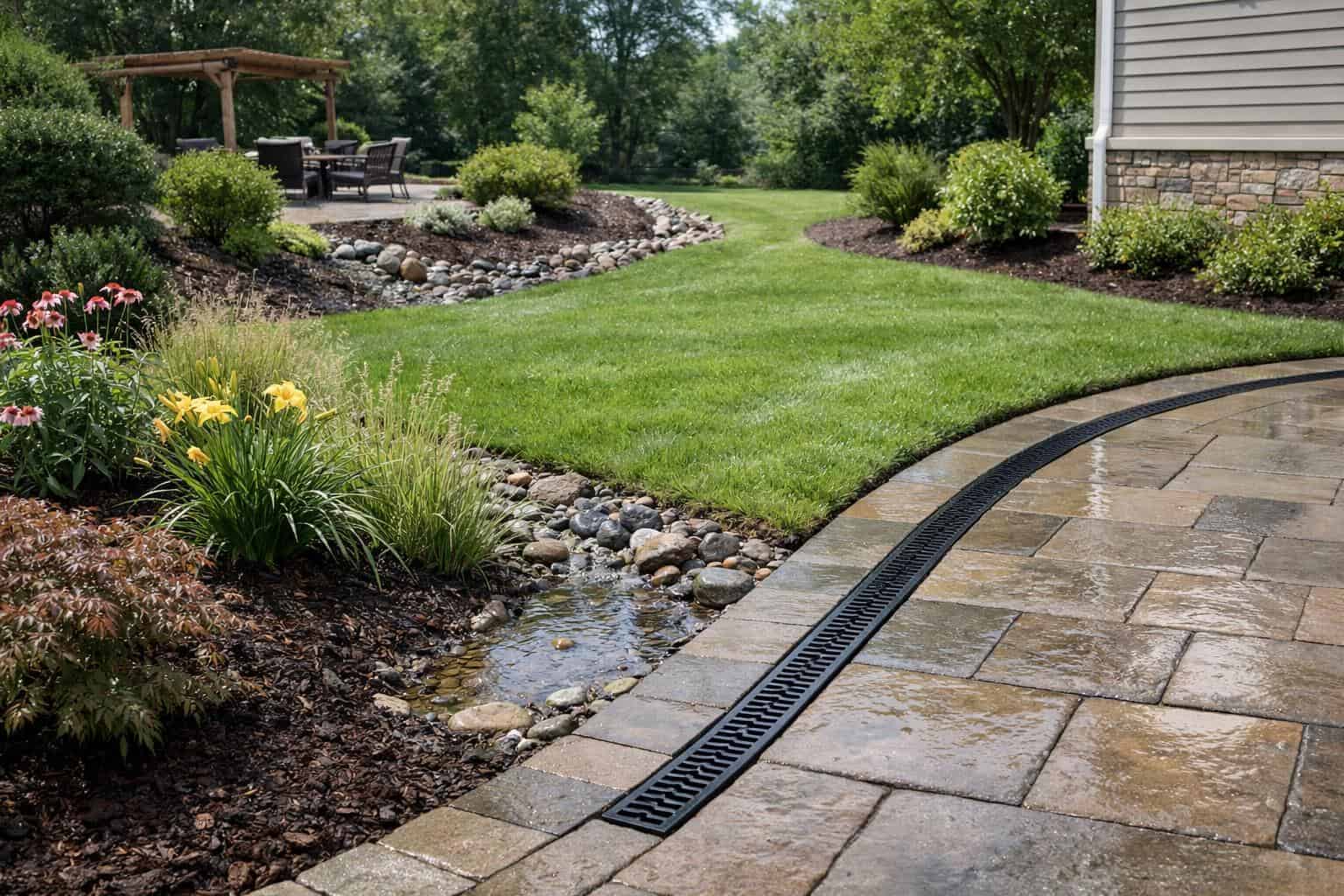
A catch basin is a grated box at a low spot; a channel or trench drain is a long, narrow grate along a patio edge, driveway or garage door. Both collect water already on the surface and move it through solid pipe to an outlet.
Dry wells and pop-up emitters
These are outlets, not collectors. A pop-up emitter releases piped water onto the lawn downhill. A dry well is an underground pit of clean stone or a plastic chamber that lets water soak in; PNNL describes a site-built one as roughly 4 by 4 feet and 4 to 6 feet deep. Dry wells fail in dense clay or a high water table, so a percolation test should come first.
Rain gardens
A rain garden is a shallow planted depression, about 6 inches deep, that catches runoff and lets it soak in. University of Rhode Island extension guidance says a well-designed one holds water only for hours, sits at least 10 feet from a basement foundation and away from septic systems and wells, and does not belong in a spot that is always wet. If a test hole does not drain within 24 hours, the site is wrong. For plant choice, see the garden bed and planting installation guide.
Sump pumps and basement waterproofing
Water already coming through basement walls or floors calls for interior drains, sump pumps or waterproofing, a separate basement project often costing $5,000–$10,000 or more. Fix the yard-side causes first, then talk to a waterproofing contractor or engineer.
How to choose: a decision checklist

Work down the list in order; many yards are fixed before step five.
- Clean the gutters and check them in a hard rain.
- Move roof water away with extensions at least 4 to 6 feet long or buried lines to a downhill outlet.
- Check the grade beside the house. If the first 10 feet do not fall about 6 inches, regrade before anything else.
- Water crossing the surface from elsewhere? Steer it with a swale or regrading along its path.
- Pooling on paving or in a low spot with no way out? Add a catch basin or channel drain with solid pipe.
- Soil soggy for days, even without puddles? That is subsurface water; a French or curtain drain fits.
- Where will the water end up? Daylight downhill is best. On flat lots, consider a dry well (only if the soil drains), an emitter, a permitted street or storm connection, or a pump.
- How close is it to structures? Water at a foundation, slab or retaining wall is high priority. A soggy corner far from the house can often just be planted with water-tolerant species.
- Check local rules. Many towns limit where you can discharge and forbid sending water onto a neighbor’s property.
Fix drainage before other upgrades. A new patio, lawn or bed built over a water problem is often damaged within a season or two, so plan drainage alongside patios and pavers, lawns and walls. If a steep slope is the real issue, see regrading vs a retaining wall.
What yard drainage costs
Drainage is usually priced per linear foot of trench or pipe, plus fixed items like basins, dry wells and permits. Short jobs carry a minimum charge. These are rounded national ranges; local prices vary by region, soil, depth, access and restoration.

| Typical project | Rough installed cost | What moves the price |
|---|---|---|
| Above-ground extensions on 4 downspouts | About $80–$800 | Splash blocks vs rigid extensions |
| Two buried downspout lines, about 40 ft total, to pop-up emitters | About $500–$1,500 | Run length, outlet type, digging conditions |
| Regrading a strip around the foundation | About $500–$3,000 | Fill volume, hand vs machine work, restoration |
| 80-ft grassed swale | About $1,000–$2,700 | Soil export, erosion matting, seed or sod |
| 60-ft shallow French drain to daylight | About $1,200–$4,000 | Depth, rock or clay, pipe type, outlet, restoration |
| Catch basin with about 40 ft of solid pipe | About $1,600–$3,700 | Basin size, pipe run, outlet |
| 20-ft channel drain at a garage or patio | About $800–$1,900 | Concrete cutting and patching, grate type |
| Dry well added to a system | About $500–$3,000 | Size, soil, gravel pit vs plastic or concrete unit |
| Whole-yard regrade with new lawn | About $2,000–$10,000+ | Area, imported fill, equipment access |
| Deep French drain along a foundation | About $50–$100+ per foot | Footing depth, hardscape in the way, hand digging |
The biggest swings come from depth, digging conditions (rock, clay, roots and hand-digging around utilities), the outlet, anything in the way such as a walkway or sprinkler lines, and restoration: bare soil, seed and sod over a trench line are very different prices. Rigid PVC costs more than corrugated pipe but is easier to clean. DIY materials for a shallow French drain run about $5–$15 per foot, plus $100–$200 a day for a trencher. To weigh the spend against what water can do to a foundation, slab or wall, see drainage cost vs property protection.
Estimate your yard drainage cost
Enter the length of the run and pick a swale, French drain, catch basin and pipe, or downspout lines to see a low-to-high installed range, a planning number to compare quotes against, not a quote.
Drainage Cost Calculator
Estimate drainage project pricing for swales, French drains, and catch basin style systems.
Drainage cost estimate
- Estimated treatment length
- –
- Low estimate
- –
- Mid estimate
- –
- High estimate
- –
- Estimated range per linear ft
- –
The calculator starts from about $10–$25 per foot for swales and downspout lines, $15–$50 for a shallow French drain and $30–$70 for a catch basin or channel run, then adjusts for access, restoration and outlet. With every option on standard, a 60-foot French drain lands around $1,200–$4,000. Foundation-depth drains, dry wells and pumps are not included; add them separately.
Installation: what a good drainage job looks like

Quality lives in details you only see during the dig, so ask to see the trench before it is backfilled.
Signs of a well-built system
- Steady fall. At least 1 percent, about 1/8 inch per foot, checked with a string line or laser so there are no low spots.
- The right pipe in the right place. Perforated pipe only where the drain collects soil water; solid pipe for roof water, basins and the run to the outlet.
- Clean stone and wrapped fabric. PNNL describes a French drain trench at least 14 inches wide with non-woven fabric, clean washed stone and 4-inch perforated pipe, holes usually down. The fabric folds over the top of the stone, not just under it.
- A named, working outlet shown on a sketch and not aimed at a neighbor’s yard.
- Cleanouts at the high end and at long runs or bends.
- Utilities located. Someone calls 811 a few days before digging. It is free and required in most states.
- Proper backfill. Soil compacted in layers, trench lines topped and seeded or sodded, spoil hauled away if promised.
Red flags during installation
- Downspouts or grates tied straight into a perforated French drain.
- Pea gravel or dirty fill, or no fabric over the top.
- No slope check, or a pipe that ends in flat ground.
- Trees or shrubs planted right over the drain line.
- Loose topsoil piled against the foundation and called regrading.
Digging often uncovers buried concrete, roots or utility conflicts. Our guide to excavation companies and what they do before a landscape project explains what a solid digging and haul-off scope covers.

Erosion control and protecting slopes
Erosion is drainage you can see. Concentrated runoff from a downspout, driveway edge or neighbor’s yard cuts channels, washes out mulch, exposes roots and undermines walks and walls. Patching the surface without redirecting the water usually fails in the next big storm.
- Move the water first with downspout lines, a swale or regrading.
- Slow it down with rock-lined swales, dry creek beds or short check steps on longer runs.
- Cover bare soil with mulch or erosion-control blankets while plants take hold.
- Plant for roots. Dense groundcovers, native grasses and shrubs hold soil better than thin lawn on a slope.
- Build structure only where needed. Steep slopes may need terracing or a wall, and a wall needs drainage behind it.
The erosion control guide goes deeper. If a wall becomes part of the plan, start with the retaining wall guide, because walls without drainage behind them often lean and bulge.
Drainage problems, repairs and when to redo the system
Most systems fail for one of four reasons: no real outlet, not enough slope, clogging, or the wrong system for the water.

| Symptom | Likely cause | Usual fix |
|---|---|---|
| Water bubbles up from a grate or emitter in every storm | Outlet blocked, undersized or uphill of the problem | Clear or enlarge the outlet, or add a second one |
| French drain worked for a few years, now the lawn is soggy again | Silt in the stone and pipe, often from missing fabric on top or roof water piped in | Flush through cleanouts; if the stone is clogged, dig up and rebuild |
| Puddle sits right over the drain line | Low spot, crushed pipe or settled trench | Camera inspection; re-lay that section |
| Downspout line backs up at the gutter | Leaves, grit or roots in the pipe, or a crushed line | Snake or flush; add a leaf strainer |
| Dry well stays full for days | Clay soil or high water table | Find a different outlet; a bigger dry well rarely helps |
| Water still reaches the house after a new drain | The real source was never fixed | Go back to diagnosis before adding pipe |
Repair when the design is sound and one part has failed. Redo when there is no workable outlet, the slope is wrong along the run, the stone is packed with silt, or the system was built for surface water when the problem is groundwater, or the reverse. A camera inspection costs far less than digging blindly.
Drainage maintenance calendar
| When | Tasks |
|---|---|
| Early spring | Clean gutters; reattach and re-aim extensions; check outlets for winter damage; walk the yard in the first heavy rain. |
| Late spring | Flush buried lines and French drains through cleanouts; weed and mulch rain gardens and swales; reseed thin spots on slopes. |
| Summer | Watch for new puddles or erosion after thunderstorms; keep mulch below siding; trim plants back from grates. |
| Fall | Clean gutters after leaf drop; clear leaves from grates, basins and channel drains; keep emitters clear. |
| Winter | In freezing climates, keep outlets from icing over and avoid sending water across walks and drives. |
| After any major storm | Check outlets, basins and slopes; note new wet spots or washouts while they are fresh. |

DIY vs hiring a drainage contractor

Gutters, downspout extensions, small grade fixes near the foundation and short buried lines are realistic weekend projects. Delaware’s state flood-adaptation guidance treats shallow French drains of about 8 to 24 inches as DIY territory, with deeper drains or those near a foundation better left to a contractor. Hire a pro for foundation-depth work, rocky ground, long trenches, street or storm connections, pumps, or any doubt about where the water comes from.
Landscape contractors, drainage specialists, excavation companies and some waterproofing firms all do this work. Our guide to drainage contractors near you explains how to compare them by diagnosis and solution fit, not just price.
Questions to ask a contractor
- Where is the water coming from, and how did you decide that?
- Would extending downspouts or regrading solve part of this for less?
- Where exactly will the water discharge, and is that allowed here?
- What pipe, stone, fabric and slope will you use, and will there be cleanouts?
- What happens if water still collects after the job?
What a drainage quote must include
- The diagnosis and why this system fits it.
- Each run’s length, depth and width on a sketch.
- Pipe type and size, perforated vs solid sections, stone and fabric.
- Outlet location and type, plus any permit and who gets it.
- Catch basins, inlets and cleanouts by number and location.
- Utility locates, haul-off, concrete cutting and patching, sprinkler repairs.
- Restoration (bare soil, seed or sod), payment schedule and written warranty.
Our checklist of what a drainage estimate should include goes line by line, and the guide to comparing landscaping quotes helps you line bids up.
Red flags in a bid
- A drain proposed with no explanation of where the water comes from.
- A one-line price with no length, depth or materials.
- No outlet named, or a dry well in heavy clay with no percolation test.
- A guaranteed dry basement from a yard drain alone.
- Pressure to sign the same day, or a large deposit before materials arrive.
Problems homeowners run into

Homeowner forums and contractor discussions keep raising the same frustrations.
- Three quotes, three diagnoses. One designer recommends a French drain, another regrading and water-tolerant plants, a third a perimeter drain with sump pumps. That spread usually means nobody traced the water.
- The drain worked, the water kept coming. The trench drained its own strip, but the source was a downspout, a neighbor’s runoff or soil sloping toward the house.
- Uphill neighbors. Yards on the low side of other lots stay soggy every rainy season. Owners who intercepted that runoff along the property line say it worked but was not cheap, and neighbor runoff disputes are often civil matters rather than something the city fixes.
- Silted or dead-end drains. Drains built with pea gravel, no fabric on top or roof water piped in fill with sediment within a few years, and drains ending in a gravel pocket in clay fill in the first big storm.
- Sticker shock on short jobs. Quotes over $5,000 for one trench along the back of a house are common when hand-digging, utilities or tight access are involved.
- Hidden leaks. Some wet spots turn out to be a broken water or irrigation line. If the yard is wet in dry weather, check plumbing and sprinklers first.
Frequently asked questions
How much does yard drainage cost?
Simple downspout fixes cost a few hundred dollars. A typical swale, catch basin or 50–100 foot French drain project runs about $1,000–$6,000. Whole-yard regrading or deep drains along a foundation can pass $10,000.
Is a French drain the best solution for a wet yard?
Only when the water is in the soil. For puddles from roof water or a bad slope, downspout lines, regrading or a swale are cheaper and work better. French drains also struggle on very flat lots with no downhill outlet.
Where should yard drainage water go?
To a lower spot on your own property where it can spread out or soak in, a dry well or rain garden in soil that drains, or a street or storm system where the town allows it. Never onto a neighbor’s lot or into the sanitary sewer.
How far should downspouts discharge from the house?
At least 4 to 6 feet, onto ground that slopes away, and farther in clay. A buried line to a pop-up emitter gets water farther away without a tripping hazard.
Do I need a permit for yard drainage work?
Often not for simple work on your own lot, but many towns require permits for curb outlets, storm connections or changes that affect neighbors. Check with your building or public works office.
Yard drainage guide library
Every drainage, grading and erosion guide on the site, grouped by decision.
Choosing a solution
- French drain vs surface drain — which drain fits water in the soil and which fits water on the surface.
- Drainage vs regrading — whether to reshape the ground or add pipe, and when you need both.
- Signs you need regrading — clues around the foundation, lawn and hardscape that the slope is wrong.
Grading and erosion
- Grading and yard leveling — what grading includes and why it comes before patios and lawns.
- Erosion control — causes of washouts and how drainage, planting and structure work together.
Costs
- French drain cost — per-foot prices, outlets, build details and cheaper fixes to try first.
- Drainage cost vs property protection — which water problems are worth paying to fix now.
Hiring
- What a drainage estimate should include — a line-by-line checklist for comparing drainage bids.
- Drainage contractors near me — how to compare local contractors by diagnosis and solution fit.
- Excavation companies near me — what excavation crews do and what their scope should cover.
More complete guides: the lawn guide for restoring grass after drainage work, the patio and paver guide, and the driveway guide, where slope and drainage decide how long the surface lasts.