
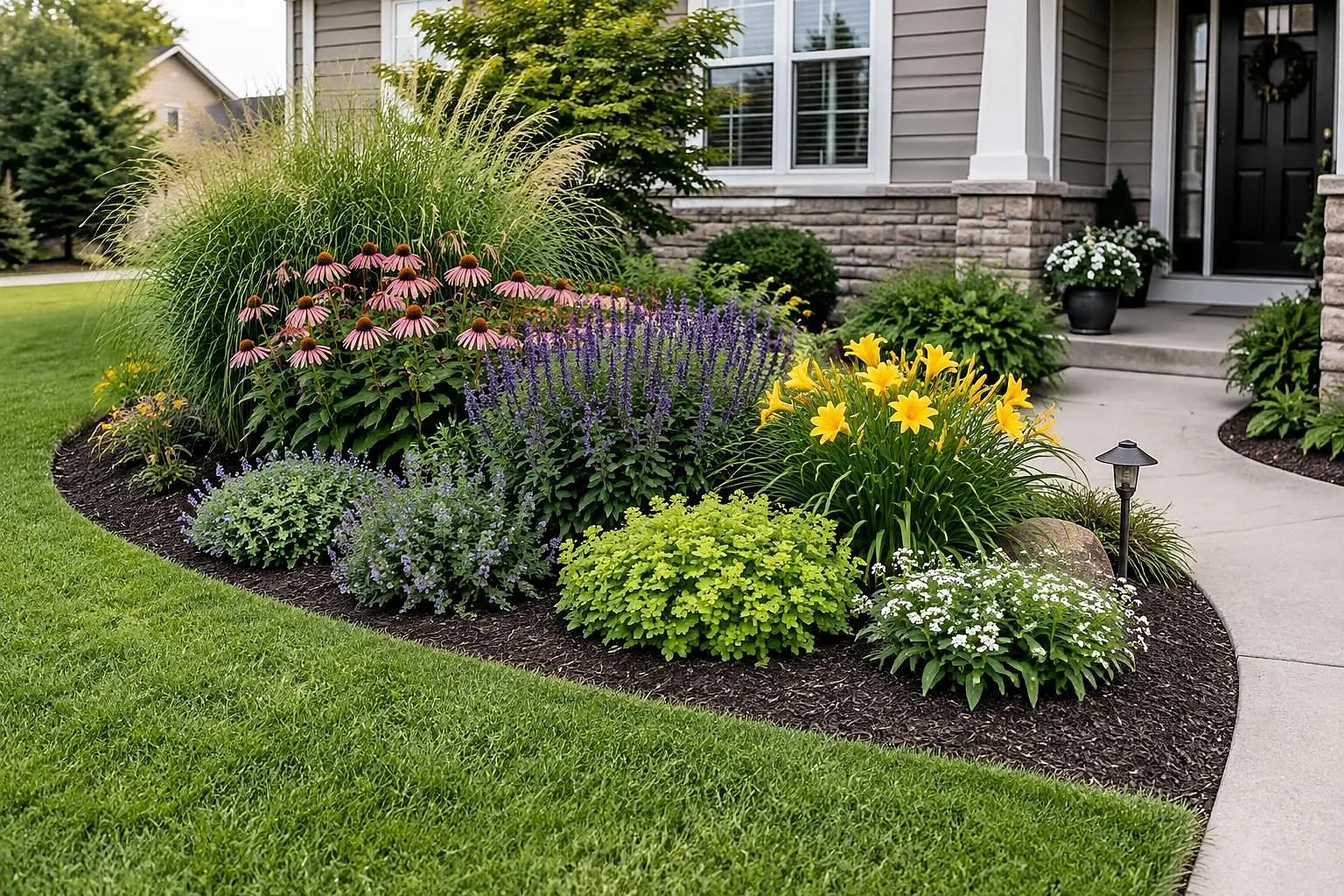
A good garden bed starts with the right spot and good soil. Pick a place with the sun your plants need. Get rid of the grass the slow, easy way, or dig it out if you are in a hurry. Work in compost, put in an edge, and mulch after planting. Make flower beds at least 4 to 6 feet deep so you can layer plants by height. Use raised beds where the soil is poor or bending is hard. Most of the cost is the plants: doing it yourself often runs $3 to $10 per square foot, and a professionally built bed $10 to $30 or more.
Quick answer: Lay out the bed with a hose and watch the sun for a day. Kill the grass by smothering it with cardboard and mulch for a few months, or by digging the sod out. Spread 2 to 3 inches of compost and work it into the top 8 to 12 inches, then plant with tall plants at the back (or in the middle of an island bed). Plant in groups of three, five or seven, spaced for mature size. Finish with a clean edge and 2 to 3 inches of mulch. Cubic yards of compost or mulch = square feet × depth in inches ÷ 324. Prices vary by region, plant size and access.

Types of garden beds: in-ground, raised and flower beds
“Garden bed” covers everything from a strip of shrubs along the house to a raised vegetable box. The type you choose decides how much digging, soil and money the project takes.
| Bed type | What it is | Best for | Main cost | Watch out for |
|---|---|---|---|---|
| In-ground bed | Planted directly in the yard’s own soil, usually with an edge between it and the lawn | Shrubs, perennials, foundation plantings, large beds | Plants, compost, mulch | Heavy clay or compacted soil needs work first |
| Flower bed or border | An in-ground bed designed mainly for color; a border runs along a fence, wall or path | Front yards, entries, along walks and fences | Plants (many of them) | Too shallow to layer; weeds before plants fill in |
| Island bed | A free-standing bed in the lawn, seen from all sides | Breaking up a big lawn, framing a tree | Plants, edging | Needs its tallest plants in the middle, not the back |
| Raised bed | A framed box (wood, metal or block) filled with a soil mix, usually 10 to 24 inches tall | Vegetables, herbs, poor or wet soil, easier reach | Frame and fill soil | Dries out faster; fill soil adds up quickly |
| Mounded (berm) bed | Soil built up 6 to 18 inches without a frame | Wet spots, adding height to flat yards | Soil | Slopes shed water and mulch; settles over time |
Most homes end up with a mix: in-ground beds for shrubs and flowers, and one or two raised beds for vegetables. If you are deciding on a raised bed, our raised garden beds guide compares cedar, metal, treated wood and block, the right width and height, and how much soil to fill one.

When a raised bed is the better choice
Choose a raised bed when the native soil is very poor, rocky, contaminated or wet, when you want to grow vegetables, or when kneeling and bending are hard. For flowers and shrubs in ordinary soil, an in-ground bed costs far less, holds water better and gives roots room to spread.
Planning a garden bed: site, sun, size and shape

Most failed beds were simply put in the wrong place. A few hours of watching and measuring saves a season of struggling plants.
Sun first
Watch the spot on a sunny day and note how many hours of direct sun it gets. Plant tags use rough bands: full sun means 6 or more hours, part sun or part shade about 3 to 6, and shade less than 3. Vegetables and most flowering perennials want full sun; tomatoes, peppers and eggplant need 6 to 8 hours, according to University of Minnesota Extension. Under mature trees, plan for shade plants and expect roots to compete for water. Our tree care guide explains why you should never pile soil over tree roots to make a bed.
Water, drainage and utilities
Avoid low spots where water stands for a day after rain unless you plan plants that like wet feet, or fix the drainage first with help from the yard drainage guide. Keep the bed within hose reach, and call 811 before digging anywhere deeper than a few inches; it is free and marks buried lines.
Size: deeper than you think
The most common design mistake is a skinny bed. A strip 2 feet deep holds one row of plants and always looks thin. Colorado State University Extension notes that flower beds look best at 6 feet wide or more. Foundation beds along the house usually need 4 to 8 feet so shrubs can sit at least half their mature width away from the wall. Plan stepping stones or a back path in any bed deeper than you can reach from the edge, so you are not compacting the soil.
Shape: smooth curves or straight lines
Lay a garden hose on the lawn to try shapes. Gentle, wide curves look natural and are easy to mow around; tight wiggles look busy and make edging harder. Straight lines and right angles suit formal houses and modern yards. Make sure the mower can follow the edge in one pass. The yard design and planning guide shows how beds fit into the layout of the whole yard, and the front yard landscaping guide covers beds that frame the entry.
Flower bed design ideas that work

Good flower bed design rests on a few rules that garden designers and extension horticulturists repeat for a reason. Once you have the bed depth, the rest is arranging plants by height, grouping and season.
Layer by height
Put the tallest plants at the back of a border, medium plants in the middle and low plants at the front edge. In an island bed seen from all sides, the tallest go in the center and step down toward every edge. A useful rule of thumb is that the tallest plants should be no more than about half to two-thirds as tall as the bed is deep. Pull a few taller, airy plants forward so the bed does not look like stair steps.
Group in odd numbers and repeat
Single plants dotted around look busy. Colorado State recommends planting the same variety in groups of three, five or seven and repeating each group two or three times across the bed. Set plants in staggered triangles rather than straight rows, and space them for their mature width from the tag, not their size in the pot. Gaps look bare for a season, but crowded plants compete, stay damp and get disease.
Plan for every season
A bed full of plants that all bloom in June is green the rest of the year. Choose plants with a spread of bloom times, from spring bulbs through summer perennials to fall asters and grasses, and add evergreen shrubs or grasses for winter structure. Foliage color and texture carry a bed between flushes of bloom.
Color and style
- Limit the palette. Two or three main colors plus a neutral (white, silver or green) look calmer than one of everything.
- Cool colors recede, warm colors advance. Blues and purples make a small yard feel deeper; reds and yellows draw the eye.
- Match the house. Loose, mixed cottage planting suits older homes; fewer varieties in bold blocks suit modern ones. Our modern front yard ideas and small front yard ideas show both.
- Low-maintenance beds lean on shrubs, grasses and long-lived perennials rather than annuals; the low-maintenance landscaping guide has plant-choice rules, and the low-water landscaping guide covers drought-tolerant beds.
How to make a garden bed in your lawn
The hardest part of a new in-ground bed is the grass that is already there. Iowa State University Extension describes several ways to clear it; the right one depends on how soon you want to plant.
| Method | How it works | Time before planting | Effort | Notes |
|---|---|---|---|---|
| Smothering with cardboard or newspaper | 6 to 8 sheets of newspaper or 1 to 2 layers of plain cardboard, overlapped, covered with compost or mulch | Several months (start in fall for spring planting) | Low | Keeps the topsoil; avoid glossy paper and waxed cardboard |
| Heavy wood chip mulch | Mow short, cover with wood chips that settle to at least 6 to 8 inches | Several weeks | Low to medium | Pull back excess chips and plant in the soil, then re-mulch 2 to 4 inches |
| Clear plastic or tarp | One light-blocking or solarizing layer, weighed down | About 6 to 8 weeks in warm weather | Low | Remove before planting; heat can also harm soil life |
| Digging out the sod | Slice under the roots about an inch deep with a flat spade or sod cutter | Same day | High | Removes some topsoil; dig a couple of days after a soaking rain |
| Tilling | Till, rake out clumps, let weeds sprout for 2 to 4 weeks, remove them, then plant | 2 to 4 weeks | Medium | Without the wait, buried grass and weed seeds come back |

Step by step
- Outline the bed with a hose and mark it with spray paint or flags.
- Test the soil through your state extension lab (often $15 to $30) so you know pH and nutrients before adding anything.
- Clear the grass using one of the methods above.
- Cut the edge with a flat spade: a straight-down cut 4 to 6 inches deep on the lawn side, sloping into the bed.
- Improve the soil with compost (see the next section). Do not work wet soil; if a squeezed handful stays in a sticky ball, wait.
- Set plants out in their pots and adjust spacing before digging any holes.
- Plant at the same depth the plants grew in the pot, water deeply and mulch 2 to 3 inches, keeping mulch off stems.
If you would rather hire this out, the garden bed and planting installation guide explains what a planting installation usually includes and what to ask before you sign.
Soil for garden beds and how much to buy
Most in-ground beds do not need new topsoil; they need organic matter. Colorado State suggests working compost or aged manure into the top 12 inches of a new perennial bed at about 3 cubic yards per 1,000 square feet, roughly a 1-inch layer. Poor or compacted soil can take 2 to 3 inches. Buy topsoil only when you are raising the grade or filling a raised bed; our soil amendment vs topsoil guide explains the difference and how to spot bad topsoil.
How much to buy
Cubic yards = square feet × depth in inches ÷ 324. For a 10 by 20 foot bed (200 square feet):
- 2 inches of compost: 200 × 2 ÷ 324 ≈ 1.2 cubic yards.
- 3 inches of mulch: 200 × 3 ÷ 324 ≈ 1.9 cubic yards.
A cubic yard is about 13 to 14 two-cubic-foot bags, so bulk delivery usually wins above 2 or 3 yards. Our landscaping calculators do the math for odd shapes, and where to buy landscaping materials compares supply yards, nurseries and big-box stores.
Raised bed soil
Raised beds are filled, not amended. University of Minnesota Extension suggests a mix of roughly one-half to two-thirds topsoil with the rest compost, plus sand if the topsoil is heavy clay; pure compost or pure bagged potting mix drains poorly and shrinks. The raised garden beds guide works through the fill for a standard 4 by 8 foot bed.
Edging garden beds
An edge keeps lawn grass from creeping into the bed and mulch from spilling onto the lawn, and it is the detail that makes a bed look finished. The cheapest option, a spade-cut trench, costs nothing but has to be recut once or twice a year. Steel and aluminum make thin, clean lines that follow curves; brick, pavers and stone add a mowing strip; poured concrete curbing is permanent; plastic is cheap but often heaves out of the ground.
| Edging | Installed cost (per foot) | Good for |
|---|---|---|
| Spade-cut edge | About $1–$3, often part of bed cleanup | New beds whose shape may still change |
| Plastic | $3–$8 | Tight budgets, short runs |
| Steel or aluminum | $5–$14 | Clean modern lines and smooth curves |
| Brick or pavers | $8–$20 | Mowing strips, traditional houses |
| Natural stone | $12–$40 | Informal and cottage beds |
The landscape edging guide compares every type, how deep each must sit to stop grass roots, and how to install it so it does not heave.
Mulch, landscape fabric and rock in beds
Mulch is the cheapest weed control there is. Spread shredded hardwood or bark 2 to 3 inches deep after planting, keep it a few inches off stems, trunks and siding, and top it up only when it thins. The complete mulch guide compares every type and price, and the mulch depth guide explains why deeper is not better.
Landscape fabric: rarely in flower beds
Fabric under mulch seems like a shortcut, but in planted beds it usually backfires. Mulch breaks down on top of it, weeds root into that layer, perennials cannot spread, and the fabric eventually has to be cut out. It works best under rock and paths. The landscape fabric guide covers where it helps and where to skip it.
Rock instead of mulch
Decorative rock and river rock last for decades and suit dry, desert-style beds, drainage areas and the strip right next to the foundation. But rock holds heat, adds nothing to the soil and is hard to remove later. Read the river rock landscaping guide and the mulch vs decorative rock cost guide before committing.
Watering garden beds
New plants need regular water until their roots grow into the surrounding soil: often every few days for the first weeks, then about an inch a week, including rain, for the first season. Water deeply and less often rather than a daily sprinkle, and water the soil, not the leaves. Drip lines or soaker hoses under the mulch use less water than sprinklers and keep foliage dry. A drip zone on a timer is the single best upgrade for a large bed. The complete irrigation guide compares drip and sprinklers, layout and costs.
What garden beds cost
The plants are usually the biggest line, so cost per square foot swings widely with how many plants you buy and how big they are. These are typical ranges; your region, access and plant sizes will move them.
| Item | Typical cost | Notes |
|---|---|---|
| Compost (bulk) | $30–$70 per cubic yard plus delivery | Delivery fees of $50–$150 are common for small loads |
| Screened topsoil (bulk) | $25–$60 per cubic yard | Only needed to raise grade or fill raised beds |
| Mulch, shredded hardwood | $38–$52 per yard bulk; $85–$125 installed | See the mulch guide for other types |
| Perennials | Often $8–$20 per 1-gallon pot | Smaller plugs cost less and catch up quickly |
| Shrubs | Often $25–$60 per 3-gallon pot | Larger sizes cost much more |
| Edging | $1–$40 per foot installed | Spade-cut to natural stone |
| Raised bed with soil | $160–$650 DIY; $400–$1,500 hired | Per bed; see the raised beds guide |
| New in-ground bed, DIY | Roughly $3–$10 per square foot | Mostly plants; less with small plants or divisions |
| New in-ground bed, professionally installed | Roughly $10–$30+ per square foot | Includes grass removal, soil prep, plants, edging and mulch |
For how bed costs fit next to other projects, see the landscaping cost and hiring guide.
Garden bed care calendar
| Season | Tasks |
|---|---|
| Early spring | Cut back dead perennial stems and grasses, rake old mulch, recut spade edges, pull early weeds while small |
| Mid to late spring | Plant and divide, top up thin mulch to 2–3 inches total, check drip lines, add compost if a soil test calls for it |
| Summer | Water deeply in dry spells, deadhead spent flowers, weed every week or two, stake tall plants |
| Fall | Plant shrubs and spring bulbs, divide spring and summer bloomers, leave some seed heads for birds, drain or winterize irrigation |
| Winter | Plan changes, order seeds and plants, keep heavy snow from piling on shrubs |
Perennials usually need dividing every three to five years when they crowd or flower less; Colorado State advises dividing spring and summer bloomers in fall and late bloomers in spring.
DIY vs hiring help
Most homeowners can make a small bed themselves over a weekend or two. Hiring makes sense for large beds, heavy sod removal, sloped sites, beds that need drainage or irrigation, or when you want a planting plan from a designer.
Questions to ask a landscaper
- How will you remove the grass, and will you replace lost topsoil?
- What compost or soil goes in, and how much per square foot?
- What plant sizes are included, and is there a plant warranty?
- What edging and mulch are included, and at what depth?
- Who waters during the first weeks?
What the quote should list
- Square footage of each bed.
- Grass removal method.
- Soil amendment amount.
- A plant list with sizes and quantities.
- Edging type and length.
- Mulch type and yards.
- Cleanup and disposal.
- Warranty terms.
Our guide on how to compare landscaping quotes shows how to line up bids that are written differently.
Red flags
- A single price with no plant list or sizes.
- Landscape fabric under every planted bed by default.
- Shrubs planted tight against the house.
- Mulch piled against stems and trunks.
- No mention of grass removal.
Common garden bed mistakes
- Beds too narrow. One row of plants against the house never looks full; go 4 to 6 feet or deeper.
- Planting for pot size. Shrubs that looked small at the nursery swallow windows and walks in three years.
- Skipping grass removal. Turning sod under or mulching straight over lawn brings grass back within weeks.
- Too many single plants. One of everything looks like a plant collection, not a design.
- Wrong sun. Sun lovers in shade stretch and stop blooming; shade plants scorch in full sun.
- Burying stems. Mulch piled against trunks and stems invites rot and pests.
- Fabric under perennials. It blocks spreading plants and ends up as a tangle of exposed fabric.
- Watering a little every day. Shallow watering grows shallow roots that wilt in the first heat wave.
Frequently asked questions
How do I start a flower bed from grass?
Outline the bed, then smother the grass with cardboard and mulch for a few months, or dig out the sod if you want to plant right away. Add compost, cut an edge, plant and mulch.
How deep should a flower bed be?
At least 4 to 6 feet from front to back if you want layers of plants. Foundation beds with shrubs often need 6 to 8 feet so shrubs can sit away from the wall.
How deep should the soil be in a garden bed?
Most perennials and shrubs root in the top 12 inches or so, so loosen and amend that layer. Raised vegetable beds work well at 10 to 12 inches of fill over loosened native soil.
Should I put landscape fabric under my garden bed?
Usually not in planted beds. A 2 to 3 inch layer of mulch controls most weeds and lets plants spread. Fabric works better under rock and paths.
What is the cheapest way to make a garden bed?
Smother the grass with free cardboard, top it with free wood chips from a tree service, add compost, cut a spade edge and plant small plants or divisions from friends.
When is the best time to make a new garden bed?
Start smothering in late summer or fall for spring planting. If you dig the sod out, spring and early fall are the best times to plant.
Which is better, raised beds or in-ground beds?
In-ground beds cost less and suit flowers and shrubs in decent soil. Raised beds win for vegetables, poor or wet soil, and easier reach.
Garden bed guide library
Every detailed guide on building and caring for garden beds, grouped by decision.
Types of beds
- Raised garden beds — materials, sizes, soil fill, costs and how to build one.
- Garden bed and planting installation — what a hired planting job includes and what to ask before hiring.
Edges and ground covers
- Landscape edging — steel, aluminum, plastic, stone, brick and curbing compared, with costs and installation.
- Landscape fabric — when it helps, when it hurts, and how to lay it.
- River rock landscaping — sizes, coverage, costs and where rock works better than mulch.
- Complete mulch guide — types, amounts, prices and care.
- Mulch vs decorative rock cost guide — which costs less over several years.
Soil and water
- Soil amendment vs topsoil guide — when beds need compost and when they need more soil.
- Complete irrigation guide — drip and sprinklers for beds and lawns.
Design and planning
- Front yard landscaping guide — beds that frame the entry and suit the house.
- Low-maintenance landscaping guide — plant and bed choices that cut weekly work.
- Low-water landscaping guide — drought-tolerant beds and planting.
- Landscaping materials guide — soil, ground covers, edging and hardscape chosen as one plan.
Sources: Iowa State University Extension, How to kill grass to create a new garden bed; Colorado State University Extension, Perennial gardening; University of Minnesota Extension, Raised bed gardens. Cost ranges are typical U.S. figures from supplier and installer pricing and other guides on this site; they vary by region.